Best Biopharma Data Providers: 6 Platforms Compared
The best biopharma data provider depends on the job. Zymewire is our pick for early-stage and signal-based biotech prospecting, SciLeads for scientific-activity research, GlobalData for broad enterprise intelligence, Patsnap Synapse for asset and partnering research, BiopharmIQ for lower-cost self-service, and BioPharmGuy for a straightforward spreadsheet.
This comparison combines published product information with pricing available upon last review and the contact-data feedback we hear from commercial teams. Prices and packages can change, so confirm the current terms before buying.
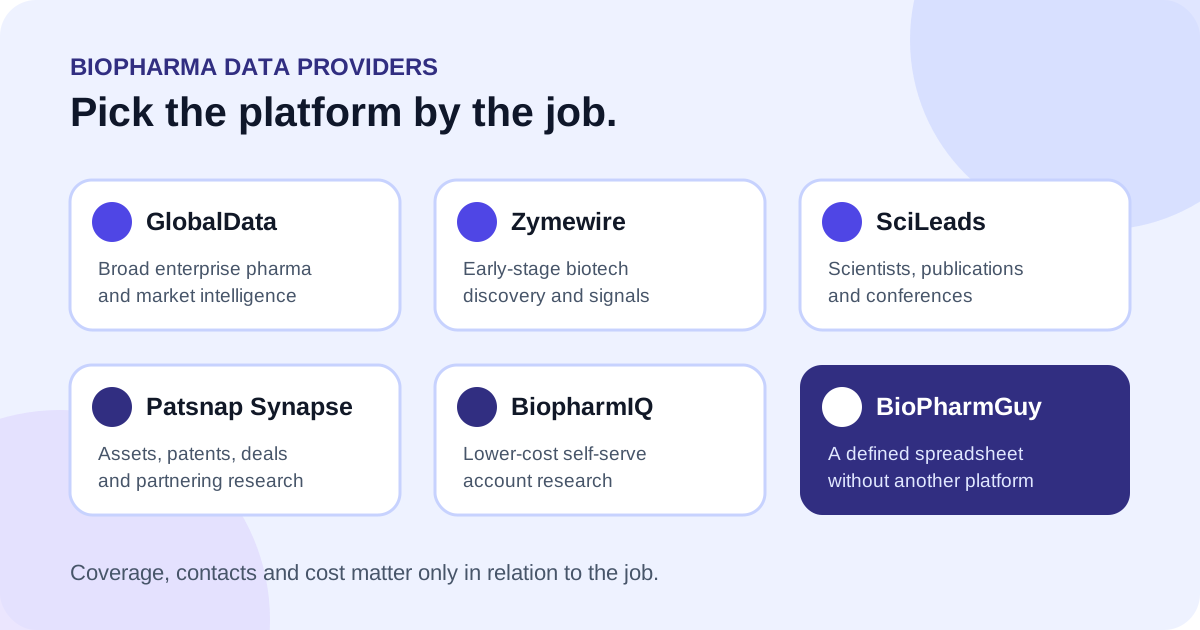
| Platform | Best fit | Starting price or buying model |
|---|---|---|
| GlobalData | Broad enterprise pharma and market intelligence | Upon last review, $20,000-$30,000; request a current quote |
| Zymewire | Early-stage biotech discovery and signal-based prospecting | Upon last review, about $750 per user per month |
| SciLeads | Scientific activity, grants, publications and conference research | Upon last review, quote only; one-week trial available |
| Patsnap Synapse | Drug, target, deal, patent and partnering research | Upon last review, about $40,000 per year |
| BiopharmIQ | Lower-cost self-serve biotech account research | Upon last review, free tier; Individual listed at $1,000 per year |
| BioPharmGuy | A defined Excel dataset without a live platform | Upon last review, $249 minimum; packaged datasets cost more |
Choose the platform by the job it needs to do
Biopharma data providers are not interchangeable. Some help a sales team discover young biotech companies. Others help a licensing team understand drug assets, patents and deals. A third group is strongest when scientific activity, publications or conferences define the right target account.
Buying the deepest database for a simple prospecting job is an expensive way to admire columns nobody uses.
Start with the output. If the team needs a qualified account list, prioritize company coverage, useful filters and exports. If publications or conferences define the market, prioritize scientific-activity data. If it is evaluating assets or partnerships, prioritize pipeline, target, trial, patent and deal depth.
The six platforms below cover different parts of that workflow. Our recommendation is to choose the narrowest product that answers the commercial question, then validate the important account details before outreach.
- Define whether the main job is account discovery, scientific-activity research or asset intelligence.
- Test known companies before trusting headline record counts.
- Calculate the cost per usable account record, not only the subscription price.
- Confirm exports, credits, user seats and CRM workflow in the trial or demo.
GlobalData pros and cons: broad intelligence at an enterprise price
GlobalData is the strongest fit here for a larger team that wants company, drug, clinical-trial, market, deal and contact intelligence from one provider. Its pharmaceutical platform covers pipelines, marketed drugs, trials, sites, investigators, deals, forecasts and regulatory events. That breadth can support market analysis, account selection and competitive intelligence without stitching together as many separate sources.
The contact product currently advertises 441,381 records across 18,698 public and private companies. GlobalData says records are collected daily with a one-to-two-day lag, and confirmed email is supplied where available. Its leads data can also surface upcoming development milestones, which is more useful for timing research than a static company list.
The main drawback is cost. Upon last review, GlobalData pricing started around $20,000-$30,000. That was a vendor quote, not a public list price, and the final number will depend on modules and access.
A team using the wider market and pipeline intelligence may justify it. A small outbound team that only needs a few hundred target accounts probably will not.
Contact quality is the other caution. We have heard repeated complaints about inaccurate contact information. That feedback is not an independently measured accuracy rate, but it is enough that we would not enroll every exported contact without checking current employment, role and deliverability first.
- Pros: unusually broad pharma intelligence, forward-looking milestones and global company coverage.
- Pros: useful when strategy, competitive intelligence and sales share the same source.
- Cons: enterprise-level starting price and more depth than many outbound teams need.
- Cons: validate contacts carefully because we repeatedly hear accuracy concerns.
Zymewire pros and cons: our top pick for early-stage biotech discovery
Zymewire is our top choice for finding early-stage biotech companies. In our experience, it identifies newly formed and low-profile biotechs better than any other platform we have evaluated. That matters to CROs, CDMOs and scientific service providers that want to build relationships before every competitor has found the same account.
Zymewire is also likely the best platform in this group for signal-based prospecting. It combines company filters with funding events, grants, development milestones, preclinical activity, planned trials, executive changes and conference participation. BiopharmIQ is the runner-up in this category, particularly for funding and emerging-company alerts.
Zymewire can also surface stealth companies before they have much of a public footprint. The Salesforce-focused Zoudini product adds daily account enrichment for teams that want those fields inside their CRM.
Upon last review, Zymewire pricing started around $750 per user per month. Zymewire does not publish that price, so ask for a current quote and check how metered company exports and contact credits affect the real cost. The published export workflow can consume an allowance for each selected data point, with up to eight fields per company.
Contact accuracy remains the weak spot. We commonly hear complaints about incorrect contact information, even though Zymewire says it verifies email deliverability. We would use Zymewire to find and understand the account, then verify the people through another source before calling or sequencing them. One database does not have to win every event in the decathlon.
- Pros: the best early-stage biotech discovery we have seen and likely the strongest signal-based prospecting.
- Pros: built specifically for service providers selling into biotech and pharma.
- Cons: upon last review, about $750 per user per month, plus metered usage to understand.
- Cons: company discovery is stronger than the contact accuracy feedback we hear.
For help putting research and outreach into practice, explore Accel Bio’s life-science lead generation.
SciLeads pros and cons: strongest when scientific activity defines the account
SciLeads is the most natural fit when scientific activity helps define the right account. It connects research organizations with publications, grants, clinical trials, conference activity and public purchasing records. That makes it particularly useful for companies selling instruments, reagents, assays, software and research services to laboratories or research-led organizations.
The strongest account-level use case is scientific context. A salesperson can find organizations active in a particular technique, identify institutions represented at a conference, and see public grants or purchases that make an account worth researching. SciLeads also documents Salesforce and HubSpot workflows, saved searches, alerts and a one-week trial.
The tradeoff is focus. SciLeads covers academia, government laboratories and applied science alongside commercial biopharma, so a team selling only to drug developers may need more filtering. Its purchasing data comes from public and declared transactions, not a complete record of private buying. Upon last review, pricing was quote-only.
Official SciLeads pages currently give different totals for researchers and events, so treat the headline counts as moving estimates. Use the trial to test the exact countries, institutions, industry employers and job functions you need. A database of millions is comforting until your twelve target scientists are the twelve it missed.
- Pros: detailed scientific context from publications, grants, events and public purchases.
- Pros: especially useful for account selection and conference planning.
- Cons: broad academic coverage can add filtering work for a biotech-only campaign.
- Cons: quote-only pricing and no public contact-coverage percentage by market.
Patsnap Synapse pros and cons: excellent depth that most sales teams will not need
Patsnap Synapse is best for asset, target, deal and partnering intelligence. It connects drugs, diseases, clinical trials, organizations, funding, deals, patents, literature and news. Patsnap currently advertises more than 98,000 drugs and biologics, one million organizations, 1.1 million trials and results, 16 million scientific patents and 23,000 deals.
That connected view is valuable for licensing, partnership scouting, portfolio analysis, technical due diligence and competitive landscapes. If the question is why a particular asset fits a partnership strategy, Synapse can answer much more than a basic company directory. It also offers knowledge graphs, entity comparisons, dashboards and programmatic access options.
For most business-development and marketing teams, however, it is more information than the day-to-day prospecting job requires. The extra depth is nice to have, but nice to have gets expensive quickly. Upon last review, Patsnap Synapse pricing started around $40,000 per year. Patsnap does not publicly list that starting price, so confirm the current package directly.
Synapse is also not clearly positioned as a complete sales-contact tool. The public product and plan pages do not document a verified decision-maker email database or a sales CRM workflow comparable to dedicated prospecting platforms. We would use it to qualify an account or partnership thesis, then use a separate source to find and verify the people involved.
- Pros: deep connected intelligence across assets, trials, patents, deals and organizations.
- Pros: strong for licensing, partnering, R&D and competitive-intelligence teams.
- Cons: upon last review, roughly $40,000 per year.
- Cons: excessive for many sales teams and not a clear replacement for a contact database.
BiopharmIQ pros and cons: a practical self-serve starting point
BiopharmIQ is the most accessible self-serve option in this comparison. It currently advertises more than 9,924 biotech companies and 65,564 contacts, with filters for disease, technology, location, company size, ownership, clinical stage and funding. Users can export data, unlock contacts and create alerts without beginning with an enterprise sales process.
Upon last review, public pricing made budgeting easier. The free individual tier included 10 unlock credits. The paid Individual plan was listed at $300 quarterly or $1,000 annually, with Team and Deluxe plans at higher credit and seat levels. Teams should still confirm current taxes, renewal terms, export allowances and commercial API rights.
For signal-based prospecting, BiopharmIQ is our runner-up to Zymewire. Its funding, emerging-company, clinical-trial and FDA alerts can help a commercial team decide which accounts deserve attention now, without requiring the same starting budget.
BiopharmIQ is useful for building a focused account list by disease, modality, development stage, geography and funding. Those are the same starting filters we use when assessing whether a biotech could plausibly need a client’s service. The exported contact details should still be validated before outreach, especially for small private companies.
The main limitation is coverage depth. The company universe is smaller than the large enterprise platforms, and credits are consumed when users unlock contacts or export information. BiopharmIQ also says it does not publish a specific accuracy percentage and that private-company update processes are still being expanded in some areas.
- Pros: visible self-serve prices, a free entry point and relevant biotech filters.
- Pros: combines account, trial, funding and contact research in one affordable product.
- Cons: smaller published company universe and credit-gated exports or contact unlocks.
- Cons: test private-company and niche-market coverage before committing.
BioPharmGuy pros and cons: simple data without another software subscription
BioPharmGuy is the simplest option: a human-curated biotech company directory and purchasable Excel dataset. It lists 14,524 companies worldwide, including 8,228 operating in the United States as of 9 September 2026. Buyers can select regions, company types and fields rather than subscribing to a large live intelligence platform.
Upon last review, the pricing was refreshingly visible. Custom purchases had a $249 minimum, all basic US company information was listed at $699, and the full set of listed US fields was $3,492. Update subscriptions were available after the underlying dataset was purchased. The free public directory is also useful for rough market mapping before money changes hands.
The limitations are equally clear. BioPharmGuy tracks up to two direct email contacts per company, about half of whom are a CEO or president. It has relatively few scientists, engineers, purchasing or facilities contacts. Direct emails cover US-headquartered companies only, and phone data is the main company line rather than direct numbers.
BioPharmGuy therefore works best when the deliverable is a finite company spreadsheet. It is less suitable when the team needs saved searches, live alerts, CRM enrichment or deep buying-group coverage. We would expect to do separate people research and phone enrichment before turning the file into an outreach campaign.
- Pros: transparent per-field pricing, human curation and straightforward Excel delivery.
- Pros: useful for a defined market map without another software workspace.
- Cons: limited contact depth, US-only direct emails and no direct-dial phone numbers.
- Cons: no native alerting, saved-search or live CRM workflow.
The best platform may still be only the first layer of your outreach stack
A biopharma platform should help answer why an account belongs in the campaign. The next layer answers who owns the work and how to reach them. We commonly separate those jobs because the best source for pipeline, stage and funding data is not always the best source for current contact details.
For a CDMO campaign, that might mean using Zymewire or BiopharmIQ to find antibody developers at the right stage, then using Apollo to map CMC, technical operations and external manufacturing roles. For a laboratory-product campaign, SciLeads might identify active institutions or laboratories from publications and conference programs. For partnership scouting, Synapse might establish the asset fit before any contact research begins.
At Accel Bio, we recommend Apollo for people and email research based on our own experience. For phone enrichment, we use options such as Derrick or Airscale. The qualified records then move into a CRM and a call-led sequence, with email and LinkedIn supporting where the audience and offer make sense.
Whichever tools you choose, keep the disease area, modality, development stage, source date and reason for inclusion beside each account. Treat funding, trials and personnel changes as reasons to research and prioritize, not proof that budget exists or a vendor search is open. The platform supplies clues. The conversation still has to do the qualifying.
- Use one source for account fit and another for people when that produces better data.
- Verify current employment, role, email deliverability and phone numbers before outreach.
- Keep the scientific reason for targeting each account visible inside the sales workflow.
- Measure usable records and conversations, not the database headline count.
Which biopharma data provider should you choose?
Choose Zymewire when early-stage biotech discovery or signal-based prospecting is the priority, with BiopharmIQ as the lower-cost runner-up for signals. Choose SciLeads when publications, grants or conferences define the target accounts. Choose GlobalData when several enterprise teams will use broad pharma intelligence. Choose Patsnap Synapse when assets, patents and deals are central to the decision.
Choose BiopharmIQ when a smaller team wants self-serve biotech filters and visible pricing. Choose BioPharmGuy when the requirement is a clearly scoped Excel dataset rather than another daily platform.
Before committing, give every finalist the same sample task. Ask it to find a known set of companies, surface the account fields you care about, export the data you need and explain every usage limit. Then check the records manually.
The best demo is not the one with the most tabs. It is the one that produces a list your team can actually use.
Questions from commercial teams
What is the best biopharma data provider for sales prospecting?
Zymewire is our preferred option for discovering early-stage biotech companies and for signal-based prospecting. BiopharmIQ is the lower-cost runner-up for funding, emerging-company, clinical-trial and FDA signals. The right answer depends on market coverage, filters and export limits in your specific segment.
How much do biopharma data platforms cost?
Upon last review, prices varied widely: BioPharmGuy had a $249 custom-purchase minimum, while BiopharmIQ listed an Individual plan at $1,000 per year. Zymewire started around $750 per user per month, GlobalData around $20,000-$30,000 and Patsnap Synapse around $40,000 per year. Request current quotes.
Which platform is best for finding early-stage biotech companies?
Zymewire is the strongest early-stage biotech discovery platform we have evaluated. Its company-formation, funding, grant, preclinical and planned-trial signals are designed for service providers prospecting into biotech and pharma.
Which biopharma database is best for scientific-activity research?
SciLeads is the strongest fit in this group when publications, grants, clinical trials, conferences and public purchasing records help identify relevant research organizations. We do not recommend using it as the primary source for finding individual contacts within those accounts.
Can one platform provide both company intelligence and accurate contacts?
Sometimes, but test the two jobs separately. A platform may be excellent at identifying relevant companies while its contact records are incomplete or stale. Validate current employment, roles, emails and phone numbers before launching outreach.
Is Patsnap Synapse worth it for a sales team?
Patsnap Synapse can be valuable when the team needs deep asset, target, patent, trial and deal intelligence. Most routine sales and marketing teams will not need all of that depth. Upon last review, pricing started around $40,000 per year, so compare that cost with the specific decisions it will support.
About Accel Bio
Accel Bio provides account research, phone-led outreach, qualification and meeting scheduling for life-science suppliers. Meet the roles on your dedicated team.
Sources and further reading
- GlobalData pharmaceutical intelligence platform
- GlobalData pharma contacts database
- Zymewire sales intelligence solutions
- Zymewire Salesforce enrichment
- Zymewire metered downloads
- SciLeads researcher profiles
- SciLeads conference data
- SciLeads purchasing data
- SciLeads CRM integration
- Patsnap Synapse platform
- Patsnap Synapse plans
- BiopharmIQ platform, pricing and FAQ
- BiopharmIQ platform overview
- BioPharmGuy directory
- BioPharmGuy data and pricing
- BioPharmGuy database FAQ
- Apollo people research
- Derrick phone data
- Airscale enrichment
Hey if you want all this outreach work to be done for you, book a consultation with our team.